7 Must-Know Facts About the Ancient History of Lake Toba
Imagine a place so vast, its creation story involved a cataclysmic event that reshaped the very planet. This isn’t science fiction; it’s the ancient history of Lake Toba, a breathtaking natural wonder in North Sumatra, Indonesia. While its stunning beauty draws visitors today, its past is a tale of geological might and human resilience. Ready to dive deep into the secrets of this incredible caldera lake? Let’s explore 7 must-know facts about the ancient history of Lake Toba that will leave you in awe.
1. The Supervolcano That Forged a Paradise
The most dramatic chapter in Lake Toba’s ancient history revolves around its birth as a supervolcano. Approximately 74,000 years ago, a colossal eruption occurred, far exceeding anything witnessed in the last two million years. This wasn’t just any eruption; it was a supermassive volcanic eruption that created the caldera we see today. The sheer scale of this event is mind-boggling. Think of it as the geological equivalent of a world-altering event, a true testament to Earth’s raw power.
- What is a Supervolcano? Unlike regular volcanoes, supervolcanoes are capable of eruptions that are thousands of times larger, ejecting more than 1,000 cubic kilometers of material. This makes them incredibly rare and impactful.
2. A Global Winter and a Genetic Bottleneck
The consequences of the 74,000-year-old Toba eruption were felt across the globe. The immense volume of ash and aerosols ejected into the atmosphere is believed to have triggered a volcanic winter. This global cooling event lasted for years, significantly impacting climates and ecosystems worldwide. Perhaps the most debated consequence is its potential link to a human genetic bottleneck. Scientists theorize that this period of extreme environmental stress may have drastically reduced the human population, with only a fraction surviving to continue our lineage.
- Impact on Human Evolution: While the exact extent of the bottleneck is still debated, it highlights how geological events can profoundly influence the course of human history and our very genetic makeup. [Learn more about the Toba catastrophe theory here.]
3. A Caldera of Epic Proportions
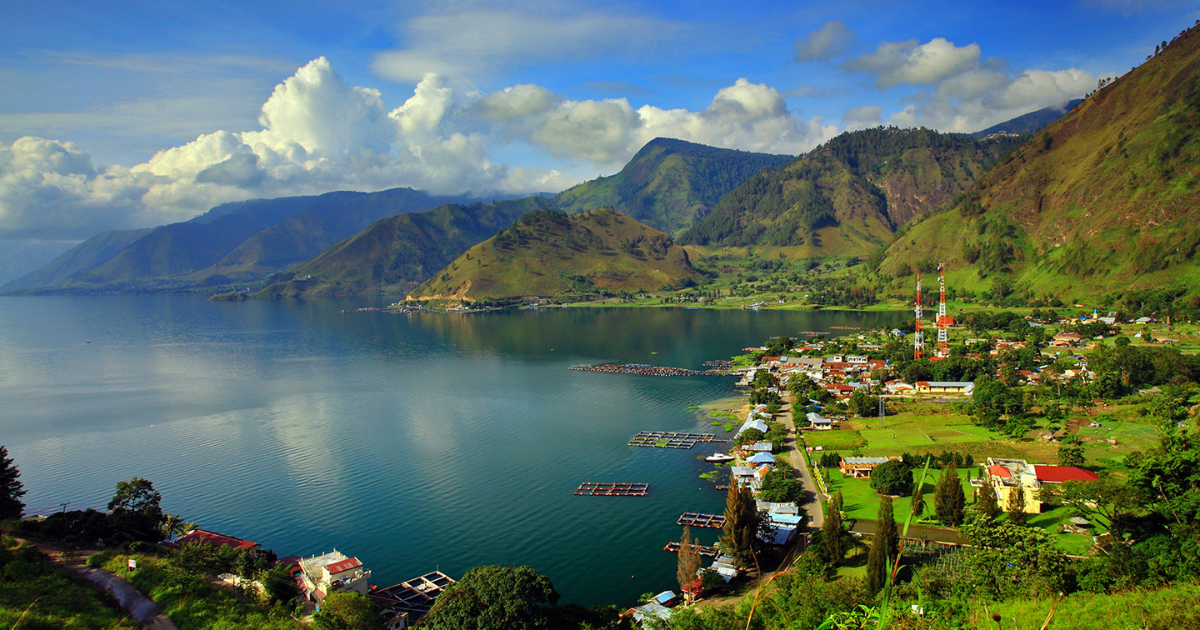
The eruption created a massive caldera, which subsequently filled with water to form the stunning Lake Toba. The lake itself is enormous, measuring an impressive 100 km long and 30 km wide, making it the largest volcanic lake in the world. Its sheer size is a constant reminder of the immense forces that sculpted this landscape. Within this vast caldera lies Samosir Island, a landmass almost as large as Singapore, offering a unique geographical feature formed by the collapsed volcanic structure.
- Geological Formation: The process involved geological up-doming, followed by massive blasts and faulting, culminating in sedimentation and the eventual formation of the lake. [Explore the geological timeline of Lake Toba.]
4. Ancient Habitation and Cultural Roots
Long before modern tourism, Lake Toba was a cradle of ancient human activity. Archaeological evidence suggests human settlement in the region dating back thousands of years, predating the supereruption. The shores and surrounding areas have been home to various groups, with the Batak people being the most prominent indigenous population. Their rich cultural heritage, unique traditions, and distinct architecture are deeply intertwined with the history and geography of Lake Toba.
- Indigenous Connection: The Batak culture, with its intricate social structures, ancestral worship, and vibrant arts, has evolved in harmony with this powerful natural environment for centuries.
5. A Landscape Reclaimed by Nature and Time
Following the cataclysmic eruption, nature began its slow process of reclamation. Over millennia, vegetation thrived, ecosystems re-established themselves, and the caldera transformed into the lush, verdant landscape we see today. This process of ecological recovery is a powerful example of nature’s resilience. The resulting environment is a haven for biodiversity, with unique flora and fauna adapted to the volcanic soils and the lake’s ecosystem.
- Ecological Significance: Lake Toba’s surrounding forests are vital for regional biodiversity. [Discover the unique wildlife of North Sumatra.]
6. Debates on the Lake’s Precise Age
While the 74,000-year-old eruption is the widely accepted theory for the supervolcano event, there have been ongoing scientific debates about the precise timeline of Lake Toba’s formation. Some researchers have explored the possibility of earlier geological processes or a series of up-doming events spanning millions of years. However, the evidence strongly points towards the supereruption as the primary architect of the current caldera structure.
- Scientific Inquiry: The ongoing research into Lake Toba’s history underscores the dynamic nature of scientific understanding and the continuous quest for more precise geological dating.
7. A UNESCO Global Geopark Legacy
Recognizing its immense geological significance and cultural heritage, Lake Toba has been designated a UNESCO Global Geopark. This prestigious title acknowledges the area as a place of outstanding geological importance, preserving its natural heritage while promoting sustainable development and community engagement. The Geopark status highlights the ongoing efforts to protect and celebrate the unique history of Lake Toba for future generations.
- Visiting a Geopark: Exploring a UNESCO Global Geopark offers a unique opportunity to connect with Earth’s history and the cultural traditions that have shaped a region. [Plan your visit to the Lake Toba Geopark.]
The ancient history of Lake Toba is a compelling narrative of creation, destruction, and rebirth. From its supervolcanic origins to its role in human evolution and its enduring cultural significance, the lake offers a profound glimpse into our planet’s past. It’s a destination that not only captivates with its beauty but also educates with its deep historical roots.
Additional Information
7 Must-Know Facts About the Ancient History of Lake Toba
Lake Toba, nestled in the heart of North Sumatra, Indonesia, is more than just a breathtakingly beautiful natural wonder. It is a landscape sculpted by immense geological forces and a silent witness to ancient human endeavors. From its cataclysmic origins to its enduring cultural significance, understanding the ancient history of Lake Toba offers a profound glimpse into the planet’s past and the resilience of human civilization.
Here are seven must-know facts that illuminate the rich and compelling ancient history of this extraordinary lake:
1. The Genesis of a Supervolcano: A Cataclysm 74,000 Years Ago
The very existence of Lake Toba is a direct consequence of one of the most significant volcanic events in Earth’s recent geological history. Approximately 74,000 years ago (with some debate pointing to a range of 33,000 to 840,000 years ago for the broader geological processes involved, but the primary caldera-forming eruption is consistently dated around 74,000 years ago), the Toba supervolcano erupted with unimaginable force. This wasn’t just a large eruption; it was the biggest eruption of the last 2 million years (Source 5). The sheer scale of this event is staggering, with its impact felt across thousands of kilometers, reaching as far as the Indian subcontinent and southern China (Source 1).
2. A Volcanic Winter that Shook the World
The immediate aftermath of the 74,000-year-old eruption was a global environmental crisis. Scientists agree that this super-eruption triggered a volcanic winter, a period of prolonged global cooling caused by vast quantities of ash and aerosols ejected into the atmosphere, blocking sunlight (Source 3). This drastic climate change would have had profound and devastating effects on ecosystems worldwide, forcing adaptation and potentially leading to population bottlenecks for various species, including early humans.
3. The Birth of a Colossal Caldera: A Lake Born from Fire
The immense eruption created a colossal caldera, the enormous crater left behind after a volcano collapses. Today, this caldera is filled with water, forming the vast expanse of Lake Toba. Measuring approximately 100 km by 30 km, Lake Toba is the world’s largest active volcanic caldera (Source 5). This geological feature is a testament to the sheer power of the Earth’s internal forces, transforming a fiery mountain into a serene, yet powerful, lake.
4. The “Toba Catastrophe Theory” and Human Evolution
The dramatic environmental consequences of the Toba super-eruption have led to the “Toba Catastrophe Theory.” This hypothesis suggests that the volcanic winter caused a significant bottleneck in the human population, drastically reducing genetic diversity. While the exact extent of its impact on human evolution is still debated, the theory highlights the profound influence of such extreme geological events on the survival and migration patterns of our ancestors (Source 3). The ancient history of Lake Toba is, therefore, intertwined with the very story of human origins.
5. A Tapestry of Geological Processes Over Millennia
While the massive eruption 74,000 years ago is the most well-known event, the history of Lake Toba is more complex than a single explosive incident. There is ongoing scientific discussion about whether the caldera’s formation was a singular event or a result of a series of geological processes that unfolded over millions of years, including up-doming, blasting, faulting, sedimentation, and up-wrapping (Source 7). This ongoing research emphasizes the dynamic and multifaceted geological journey that shaped the Toba region.
6. Early Human Habitation and Cultural Legacy
Despite the catastrophic eruption, evidence suggests that humans inhabited the Lake Toba region relatively soon after the event. Archaeological findings hint at early human presence, indicating the resilience and adaptability of our ancestors. Over millennia, these early inhabitants developed distinct cultures, leaving behind a rich heritage that continues to be woven into the fabric of the region’s identity (Source 2, Source 6). The lake has long been a significant cultural hub, influencing legends and traditions.
7. A Timeless Destination: From Ancient Geological Marvel to Modern Wonder
Lake Toba’s history is a fascinating tapestry that stretches from its ancient volcanic origins to its present-day status as a beloved tourist destination (Source 2, Source 4). The sheer scale, the dramatic landscape, and the profound historical events associated with it continue to inspire awe and wonder. Understanding its ancient past allows visitors to appreciate not only its natural beauty but also its deep connection to the Earth’s geological history and the story of human civilization.
The ancient history of Lake Toba is a compelling narrative of immense geological power, environmental upheaval, and the enduring spirit of life. It stands as a powerful reminder of the planet’s dynamic nature and the deep connections between the natural world and human history.