
In the heart of Indonesia, the island of Bali operates on a rhythm dictated by deep-rooted faith and ancient tradition. Among its many rituals, none is as visually striking or spiritually profound as Ngaben, the Balinese cremation ceremony. As we look toward 2026, interest in this sacred rite has only grown, drawing travelers and spiritual seekers who wish to understand the Balinese perspective on life, death, and the eternal journey of the soul.
Ngaben is far more than a funeral; it is a liberating rite of passage. It serves as the final, vital act of devotion that allows the soul to detach from the physical realm and ascend toward its next incarnation or liberation.

The Philosophy of Ngaben: Sekala and Niskala
To understand the spiritual significance of Balinese cremation ceremonies (Ngaben), one must first understand the Balinese concept of the universe. The Balinese believe in a dual existence: the sekala (the seen, physical world) and the niskala (the unseen, spiritual world).
Death is not viewed as an end, but as a transition. The human body is composed of the Panca Maha Bhuta—the five elements of earth, water, fire, air, and space. Through the ritual of cremation, these elements are returned to their natural state, effectively “cleansing” the soul of its earthly attachments. By breaking the physical vessel, the family ensures that the soul is no longer tethered to the material world, allowing it to move freely into the realm of the ancestors.
The Process: A Journey of Restoration
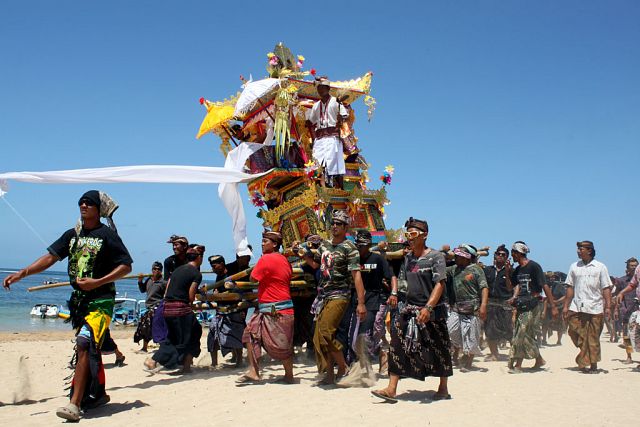
The preparation for Ngaben is a communal effort, reflecting the Balinese philosophy of Gotong Royong (mutual cooperation). It is not a somber, private affair but a vibrant celebration of life.
- Preparation: The family prepares an ornate Wadah (a towering cremation tower) and a Lembu (a bull-shaped sarcophagus). These structures are masterpieces of craftsmanship, serving as a chariot for the soul.
- The Procession: The body is carried to the cremation ground in a spirited procession. The path is often winding and noisy; this is intentional, designed to confuse evil spirits so they cannot follow the soul of the deceased.
- The Cremation: Once at the site, the body is placed inside the sarcophagus and ignited. This fire represents the transformative power of Agni (the god of fire), which purifies the soul and severs its last ties to the physical body.
- The Final Rites: After the ashes are collected, they are traditionally scattered into the ocean or a sacred river, symbolizing the return of the soul to the infinite cycle of nature.
Why Ngaben is Unique to Bali
While Hinduism is practiced in many parts of the world, the Balinese version of cremation is distinct. In India, cremation is often focused on the individual’s path to Moksha. In Bali, Ngaben is deeply communal and emphasizes harmony.
The ceremony is an act of “repaying the debt” to the ancestors. By performing Ngaben, the living family members fulfill their duty to their lineage, ensuring that the ancestor can transition peacefully. When the ancestor is at peace, they protect the living, thereby maintaining the balance between the sekala and niskala. This belief system remains a cornerstone of Balinese social structure in 2026.
Cultural Etiquette for Observers
If you are visiting Bali in 2026 and happen upon a Ngaben ceremony, it is essential to approach the event with respect and humility. While the ceremony is public, it is a deeply personal moment for the grieving family.
- Dress Appropriately: Always wear a sarong and sash when entering temple areas or observing religious processions.
- Keep Your Distance: Use a telephoto lens if you wish to capture images, and never stand higher than the priest or the cremation tower.
- Maintain Silence: While the atmosphere may be festive, refrain from loud talking or disruptive behavior.
- Ask Permission: Always seek guidance from a local guide or a family member before positioning yourself to watch.

Conclusion: Honoring the Cycle of Life
The spiritual significance of Balinese cremation ceremonies (Ngaben) lies in the profound beauty of acceptance. By embracing death as a natural transition rather than a tragedy, the Balinese people cultivate a life of gratitude and balance.
As we navigate the complexities of 2026, the wisdom of Ngaben offers a timeless reminder: we are all part of a larger cycle. Through fire, ritual, and community, the Balinese remind us that the soul is eternal, and the harmony between the seen and unseen is the greatest legacy we can leave behind. Whether you are a traveler or a student of culture, witnessing or learning about Ngaben provides a unique window into the resilient and beautiful spirit of the “Island of the Gods.”