
In the heart of Indonesia’s “Island of the Gods,” death is not viewed as a somber end, but as a vibrant, essential transition. As we move through 2026, the Ngaben cremation ceremony remains one of the most profound cultural spectacles on earth. It is a masterclass in devotion, community, and the spiritual release of the soul.
Unlike Western funerals, a traditional Balinese Ngaben is a loud, colorful, and expensive celebration. It is the final act of Pitra Yadnya, a holy sacrifice dedicated to ancestors. If you are wondering what happens during a traditional Balinese Ngaben cremation ceremony, this guide explores the intricate steps, deep symbolism, and the spiritual fire that returns the soul to the universe.
The Spiritual Meaning: Why the Balinese Celebrate Death
For Balinese Hindus, the human body is merely a temporary vessel for the soul (Atman). This vessel is composed of the Panca Maha Bhuta, or the five physical elements: Earth (Pretiwi), Water (Apah), Fire (Teja), Air (Bayu), and Ether (Akasa).
The primary goal of Ngaben is to release the soul from its earthly ties. By burning the physical body, the fire—believed to be the incarnation of Lord Brahma—purifies the soul and allows the five elements to return to the universe. This liberation is essential for the soul to either reach Moksha (liberation) or be reincarnated into a higher state.

The Preparation: Building Towers and Sarcophagi
A Ngaben ceremony does not happen overnight. In 2026, families often wait months or even years to perform the ritual, often participating in a “Ngaben Massal” (Mass Cremation) to share the significant costs.
1. The Bade or Wadhu (The Cremation Tower)
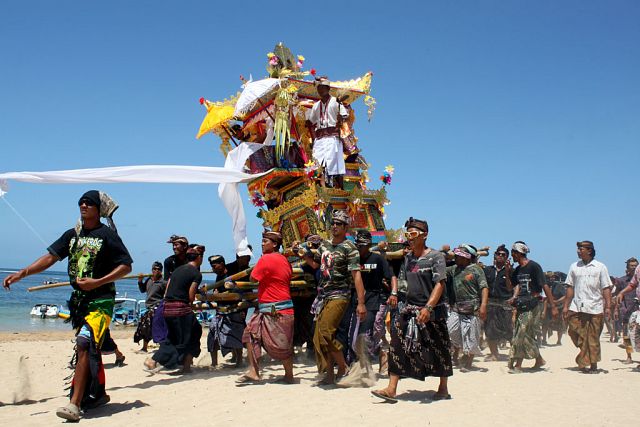
The family constructs a magnificent multi-tiered tower known as a Bade. This tower represents the Hindu cosmos. The height and complexity of the Bade often reflect the social status or caste of the deceased.
2. The Lembu (The Sarcophagus)
The body is eventually placed inside a hollowed-out wooden sarcophagus. While a black bull (Lembu) is the most iconic shape, other animals like lions or winged elephants may be used depending on the family’s lineage. These structures are intricately carved and decorated with gold foil and vibrant fabrics.
The Day of the Ceremony: A Procession of Joyful Chaos
The actual day of Ngaben is a sensory explosion. Hundreds of villagers gather to assist the family, carrying the massive Bade and Lembu on their shoulders using bamboo grids.
The Symbolic “Confusion”
As the procession moves toward the Pemaun (cremation ground), the men carrying the tower will spin it around three times at every crossroads. This is done to confuse the soul of the deceased so that it cannot find its way back to its former home, ensuring it continues its journey toward the afterlife.
The atmosphere is fueled by the rhythmic, clashing sounds of the Beleganjur gamelan orchestra. This music is intended to drive away evil spirits and keep the energy high for the grueling physical task of carrying the structures.

The Cremation Ritual: Purification by Fire
Upon arriving at the cremation grounds, the body is carefully transferred from the Bade into the Lembu sarcophagus. This is a deeply spiritual moment led by a high priest (Pedanda).
The Role of Holy Water (Tirta)
The priest pours Tirta (holy water) over the body while chanting sacred mantras. Family members place symbolic offerings, including coins, mirrors, and silk, inside the sarcophagus. These items are meant to assist the soul in its transition.
The Sacred Fire of Lord Brahma
Finally, the sarcophagus is set alight. As the flames consume the structures, the crowd watches with a sense of relief rather than sorrow. The burning fire is seen as a divine tool of purification. It destroys the “impurities” of the physical world, freeing the soul to reunite with the Creator.
Post-Cremation: Returning to the Sea
Once the fire has died down, the family carefully gathers the remaining bone fragments and ashes. These are placed in a coconut shell wrapped in white cloth.
The final stage of the Ngaben involves a procession to the nearest beach or river. The ashes are cast into the water, symbolizing the final return of the elements to nature. This act signifies that the soul has been completely severed from the material world and is now free to begin its next cycle.
Visitor Etiquette for Ngaben in 2026
Ngaben ceremonies are generally open to the public, and the Balinese are incredibly welcoming to respectful observers. However, as tourism continues to evolve in 2026, following proper etiquette is more important than ever:
- Dress Code: Always wear a sarong and a waist sash. Ensure your shoulders are covered.
- Positioning: Never stand higher than the priest or the offerings. Avoid standing on walls or chairs to get a better photo.
- Emotional Conduct: Remember that while it is a celebration, it is still a funeral. Avoid loud laughter or intrusive behavior during the prayer segments.
- Photography: Taking photos is generally allowed, but avoid using flash and never get in the way of the procession or the family.
The Cost and Community Effort
A traditional Ngaben is a testament to the Balinese concept of Gotong Royong (mutual cooperation). Because a private ceremony can cost thousands of dollars, many villages organize collective ceremonies. This ensures that every member of the community, regardless of wealth, receives a proper send-off into the spiritual realm.
Conclusion: A Cycle of Life and Death
The traditional Balinese Ngaben cremation ceremony is a powerful reminder that life and death are two sides of the same coin. In 2026, this ritual remains a cornerstone of Balinese identity—a beautiful, fiery bridge between the physical world and the divine. By witnessing or learning about Ngaben, we gain a deeper appreciation for a culture that views the end of life not with fear, but with the hope of a brand-new beginning.